Showing posts with label folklore. Show all posts

11/11 = Venice's San Martino!

Yesterday was not only the U.S.' Veterans Day, but it was also the Feast Day of Saint Martin of Tours, which is celebrated to this very day in Venice!

It's a bit like "trick or treating" in the States... Children go to shops and sing a traditional song about San Martino while banging pots and pans until the shopkeepers give them small change, and then they move onto the next shop.

I have to say though that my favorite part of the day is the decorated sugar cookie in the form of Saint Martin (who was a knight on horseback until his religious conversion)... Here's a particularly ginormous and ornate one!

You can see more photos at the great blog Venice from beyond the bridge!

Magnificent Pakistani (and Sicilian!) Car Decorations

Gorgeous collection of photos capturing the Pakistani tradition of elaborately decorating their vehicles. According to Drive Line:
The most striking thing in Pakistan is the vision of trucks and buses completely covered in a riot of color and design. They might spew diesel fumes, they may take up all of the winding, narrow, under-maintained road one is trying to negotiate, but they are certainly noticeable, like so many mechanical dinosaurs adorned in full courtship colors.

The decoration of vehicles is a common practice in a number of countries in addition to Pakistan. Similar techniques and materials are employed in truck and (more frequently) bus decoration in the Philippines, Indonesia, and several countries in Central and South America; in South Asia itself, Indian trucks are painted, as are the scooter rickshaws, called "Baby Taxis", of Bangladesh. What makes the case of Pakistan unique, however, is the pervasiveness of vehicle decoration, since decoration is heavily utilized on virtually all privately and fleet-owned commercial vehicles, from the well known trucks and buses, to vans, share taxis, animal carts and even juice vendors' push carts.

The motifs on the trucks can be categorized in five groups:
1. Idealized elements of life, such as the romanticized village, landscapes or beautiful women.
2. Elements from modern life, such as pictures of political figures or patriotic symbols.
3. Talismanic and fetish objects, such as horns, yak tails and items of clothing.
4. Talismanically or religiously loaded symbols, such as eyes and fish.
5. .Obvious religious symbols and images such as Buraq (a celestial horse that is believed to have carried the Prophet Muhammad on a spiritual journey to heaven).

However, by far the commonest religious symbols appearing on a truck are the Ka'ba and Prophets mosque, appearing on the left and right of the front of the truck somewhere towards the top.

Interestingly, half a world away, some Sicilians (whose culture was also influenced at one time by Islam; coincidence?) used to decorate first their horse carts and then their cars in a a similar kind of way. (The Fiat 500 at left is absolutely fabulous!)

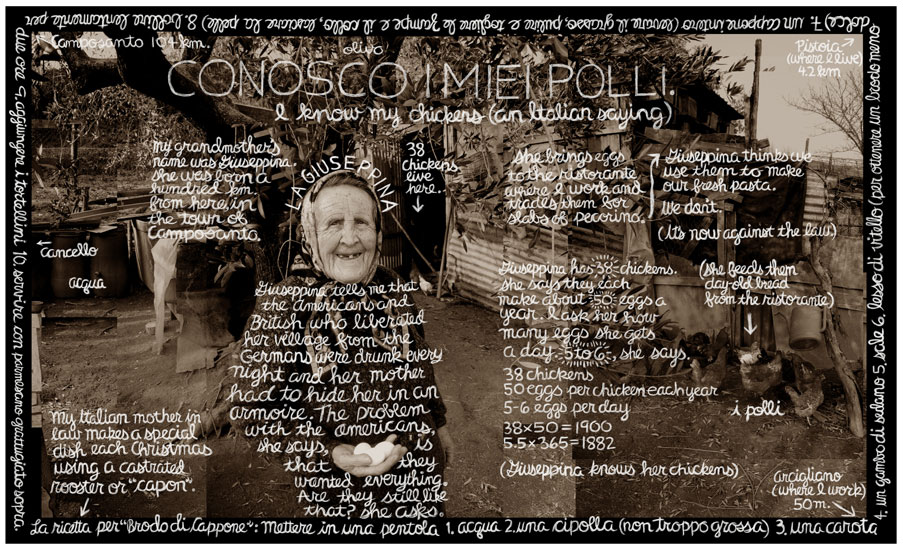
"I know my chickens"


Italian sayings are wonderful! "I know my chickens" - originally a farmer's proverb - would roughly translate now as "I know of whom I speak."

The image above is the work of photographer, filmmaker, and multimedia artist Douglas Gayeton, who has a show opening this weekend in California. For those who can't make the trip, here's what Boing Boing has to say about Gayeton's art:

Douglas Gayeton has explored Tuscany and the heart of Italy's "Slow Living" culture since the early 90's. With a keen eye for stories and an ear for Italian dialect, he he intertwines the literal with the figurative in a photographic approach he calls the flat film. To become immersed in one of these works is to experience a world where time is at once collapsed and expanded. Regarding his work process, Gayeton says, "I've always seen photography as being about a single moment, whereas film is about orchestrating a sequence of moments (scenes) to create a larger narrative.
The mix between the realism of Gayeton's photojournalistic photography and the text reflecting Italian popular culture and the oral history of the subject seems a perfect way to transcend "the single moment" and create that larger narrative! (Reminds me a bit of a kind of refreshingly-grounded, photographic version of this lyrical mix by Howard Finster...)

More of Gayeton's work is available on PBS's website in a five-part photo essay called "My shoes are caked with mud: a Tuscan photo diary." I look enthusiastically forward to seeing even more from Douglas Gayeton, and hope you do, too! Enjoy!!

Getting ready for the Palio!

Here are some more snapshots taken in Siena during preparations for the last Palio in July. (You can read, if you'd like, my blog post about it here!)


These shots are mostly of the little contradaioli, the little kids of each neighborhood who get free bleacher seats for the trial runs (and intensive socialization in their neighborhood fanaticism!)


Want to see more? The next Palio will be run Aug. 16!