Yesterday was not only the U.S.' Veterans Day, but it was also the Feast Day of Saint Martin of Tours, which is celebrated to this very day in Venice!
It's a bit like "trick or treating" in the States... Children go to shops and sing a traditional song about San Martino while banging pots and pans until the shopkeepers give them small change, and then they move onto the next shop. I have to say though that my favorite part of the day is the decorated sugar cookie in the form of Saint Martin (who was a knight on horseback until his religious conversion)... Here's a particularly ginormous and ornate one!
Yesterday, I caught the ferry boat that takes cars to Venice's beach island, the Lido. It passes through the wide Giudecca canal that forms the underbelly of the city, where you can get some unparallelled great Venetian views!
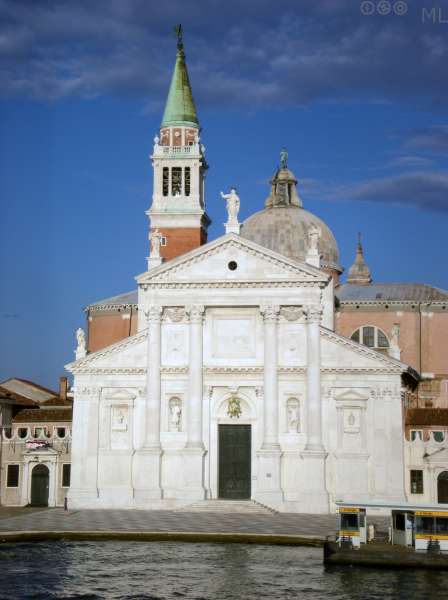
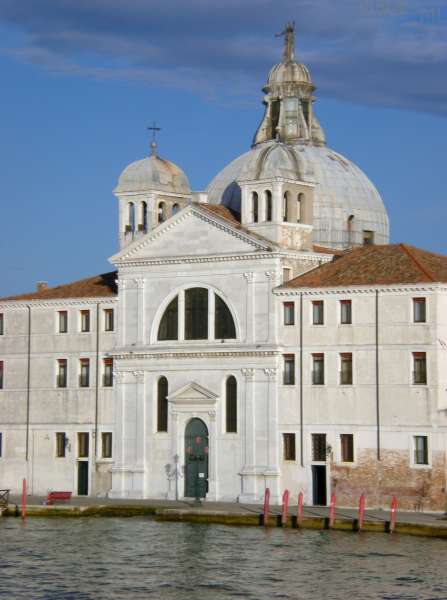
To wit, in one fell swoop, you can get a spectacular gander of not one BUT THREE churches designed by the virtuoso Renaissance architect Andrea Palladio!
As proof, I've uploaded to Flickr these shots of mine taken of the gleamingly gorgeous sixteenth-century white marble churches of San Giorgio Maggiore, the Zitelle, and the Redentore. Enjoy!!
Today was the annual celebration of Venice's "Marriage to the Sea," and a wonderful reminder of why I love this city.
It was Nan McElroy's blog Living Venice that reminded me that this weekend was the Feast of the Ascension, celebrated in quite a particular way by Venetians.
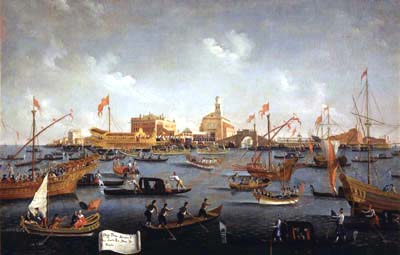
The "Festa della Sensa," as Venetians call it, has been celebrated for nearly a millennium. Probably the best read you can find about it is in Ed Muir's Civic Ritual in Renaissance Venice, but - as a quick intro - I can tell you that every year on the traditional Catholic feast day celebrating Christ's Ascension into Heaven after his Crucifixion, the city would take to its boats and row out to the end of the Lido barrier island, right in front of the Benedictine church and monastery of San Nicolò (as you can see in the image by eighteenth-century Venetian painter Gabriele Bella).
There, the Doge (the ceremonial head of the government) would drop a ring into the water, precisely where the Venetian lagoon met the Adriatic Sea, saying "We wed thee, O sea, as a sign of our true and perpetual dominion." (What can I say? Venetians were legendary for being more pragmatic than romantic!)
Today, a similar ceremony occurs, with the mayor standing in for the doge. But what really got me today was getting to wander around the old monastery complex of San Nicolò and the concert of seventeenth-century music which concluded the day's festivities.
Firstly, a couple of iPhone pics of San Nicolò... While most of the complex that one sees today (at left) is later than the sixteenth century, I have a soft spot in my heart for any and all remnants of the early Middle Ages. Sure enough, there is preserved a section of Romanesque-Byzantine mosaic pavement and some columns from the ruins of the nave of the older church, about a thousand years old! Even better is an easy-to-overlook tiny fragment of relief of an eagle, probably meant to be a symbol of the Saint John who is believed to have written one of the Gospels. But the evening's concert held in the church was the best part of the day! Firstly, as is the case with so many cultural events here sponsored by groups like Musica Venezia, it was FREE! (Particularly amazing when you consider that you'd be hard pressed to find anything of the like stateside at nearly any price!)
Secondly, the musicians (from the group VeniDilecteMi) were fantastic (6 male & female vocalists, 2 violinists, a viola, 1 lutist, and an organist), and performed music composed more or less at the same time as the present church of San Nicolò was itself was built, that is, during the 1600s.
As you can see, it was the perfect setting for these beautiful sounds, many of which had been taken directly from seventeenth-century music books and had never been performed in recent times!* (BTW, while the church is about 400 years old, the crucifix you see in the photo at left dates back about SIX HUNDRED YEARS, to the fifteenth century!)
Most of the works performed were very short, just a few minutes long, and written by minor, lesser-known composers of the time. But still Venice was a major cultural center of Europe, and was absolutely saturated with wonderful music by composers of all levels!
Here, for posterity's sake, is the great program they performed (with the pieces that really struck me in bold):
G.B. Bassani, Suonata IX (1683)
A. Balbi, "Laudabo nomen Dei" (1606)
A. Grandi, "Vocem Iucunditatis" (1637)
A. Grandi, "Quasi Cedrus" (1630)
A. Balbi, "Exsurgat Deus" (1606)
J.H. Kapsberger, "Toccata III" (1604)
F. Lucio, "Jubilate Deo" (1649)
A. Grandi, "In dedicatione templi" (1618)
A. Gabrieli, "Ego rogabo" (1576)
A. Grandi, "Bone Jesu Verbum Patris" (1621)
B. Marini, "Zarabanda III" (1655)
A. Grandi, "Benedictus Dominus" (1610)
J.H. Kapsberger, "Preludio in sol" (1640)
A. Grandi, "Deus canticum novum" (1628)
B. Marini, "Sinfonia IV tuono" (1655)
A. Grandi, "Anima mea liquidfacta est" (1630)
F. Cavalli, "Canzona a 3" (1656)
C. Monteverdi, "O Jesu vita mia" (1603)
G.B. Bassani, "Suonata VI (1683)
A. Grandi, "Memoriam fecit" (1621)
A. Grandi, "Ave maris stella" (1637)
C. Monteverdi, "Cantate Domino" (1620)
I'll just say one more thing: I learned today that there were a number of lesser-known composers whose work I really enjoyed. But then there was Monteverdi! (Along with Andrea Gabrieli, Monteverdi was the only other composer played today who was at all well-known; indeed, he is considered one of the earliest innovators of opera and is buried with honor in Venice's splendid Frari church).
As the program today said in his biography, "Claudio Monteverdi is one of the absolute musical geniuses of all time." Turns out that this is no understatement. After listening to several perfectly nice pieces by the minor composers of the era, I was utterly blown away by Monteverdi's "O Jesu vita mea"! There was simply no comparison between the unabashed virtuosity of his piece and the others. In fact, one of the earlier works had been called "Anima mea liquefacta est," which means "My soul is liquefied," and that was exactly how Monteverdi's composition - consummately performed in a lovely church constructed at just about the same time as his writing - made me feel! (Have I mentioned lately that God, I love this city?!)
*BTW, anyone interested in recuperating and performing this ancient music can find the musical notation for these pieces and others like them here!
"INSPIRED BY THE Metropolitan Museum of Art’s exhibition 'Venice and the Islamic World, 828-179'” (see July 2007 Washington Report, p. 43), this reporter recently traveled to the canal-laden city to seek out the art, in situ, which was influenced by the Islamic world..." (more at Travel Tips: In Search of Islamic Venice)
Originally, I was going to take these photos and blog about religious processions in Italy.
(I'm not Catholic - at least not in any way, shape or form "officially" - but I love watching Italian religion processions. My favorite so far was probably the one when the entire village of Capri in southern Italy carried this impossibly heavy statue of the Madonna all the way up the hillside to a little sanctuary, at which point the band inexplicably broke into a rousing rendition of the "Mexican Hat Dance"! LOL)
I went to the saint's day celebration of Saint Anthony of Padua on Wednesday, where the main event is likewise a procession of the saint's huge votive statue through the streets of the city, together with lots of marching bands, boy scouts, firefighters, etc. all parading with him. You can see the Saint Anthony just being carried out of his basilica at right...
But then the sky on the horizon suddenly turned black with storm clouds and it started to rain... The next time I saw Saint Anthony at the end of the procession, he was going about twenty miles a hour as the folks carrying him sprinted for shelter in the church, just before all hell (pardon the expression since I'm talking about a saint!) broke loose with the weather. (See the picture... He was literally just a blur!!)
And all those people you saw above in the piazza? They all took cover under the relatively narrow archways lining the streets, where thousands of people were then crushed together tighter than sardines so that you literally couldn't move. I conveniently decided to take refuge both from the crowd and the storm in a nearby wine bar... (Hey, there are worse ways to pass a thunderstorm!) I did however come out just in time to get a picture of a double rainbow!!
Anyway, the very same thing happened yesterday, with far more devastating results. I don't know if you all heard about the disaster at the rock concert in Venice... No joke!
I had even thought seriously about going to the Heineken Jammin Festival: 4 days of music in a part of Venetian mainland, including the Killers, Linkin Park, My Chemical Romance, Iron Maiden, Smashing Pumpkins, Pearl Jam, and Aerosmith... But then I heard that the concert organizers were expecting 300,000 people from all over Europe, and I decided that I no longer had the courage to face such a monster concert, and I'm not sure I really ever did in the first place! :-)
Good thing! Weather's not usually too extreme around here, but with global warming and all, it's been acting more and more sub-tropical in recent years, with those relatively rare, but sudden, violent thunderstorms like I saw in Padua.
In fact, the festival had literally just opened, and only a few hours before Pearl Jam was due to take the stage, a sudden squall with hail and wind gusts estimated in excess of 90 kph hit the open field where the concert was being held, and brought 8 of the 10 huge light and speaker towers down on some of the concert-goers... Last I heard something like 50 people were injured with broken bones and the like, but thankfully no one was killed!
I could be wrong, but it does seem that I've been seeing more and more of these violent summer storms around Venice in recent years. I hope that before Venice sinks from global warming that it's not blown off the map first!!