Well, as you can see in the sidebar, I do more FBing of my interesting weblinks than blogging nowadays, but I thought these photos were worth firing up Blogger for! ☺
First thing to know is that these originate from Instagram, a free iPhone app that's also fast becoming a photosharing sensation, not to mention a global social-network community for enjoying others' photography! (Those who don't use the iPhone or iPad can vicariously appreciate Istagram-ography by observing a live-stream of photos as they are being uploaded from all over the world at Hashtagram or by using the Webstagram service. FYI: I'm on there as @misciel!)
Now, the photo here is from Instagram user @mariannehope, a Norwegian who usually lives in Holland and typically shoots lovely desaturated, minimalist images of still-lifes and panoramas. That's why these images caught my eye... not like her usual style at all. Turns out that's because she wanted to give a strong sense of this fascinating building!
It is the Tønsberg Library, which she just visited. According to Wikipedia, Tønsberg is generally regarded as the oldest town in Norway, and they've got the ruins to prove it! As Marianne writes,
What's special about this building is that it's built on and around ancient ruins from the year 1180, the ruins of a convent. They also found 6 graves from the Vikings on the grounds. The building was built in 1992 and is a fantastic piece of modern architecture mixed in with the historic stones.
Two very different shots from my jaunt back in early August to the colorfulisland of Burano in the Venetian lagoon, taken expressly for this week's PhotoHunt theme, "framed"!
Here, I'd turned a corner in Burano and stumbled upon what was once a Venetian Gothic window that had been turned into a brightly painted, impromptu shrine with the addition of this improbably small icon. Still, it made a perfectly unique frame.
Below, on the other hand, is a view of the 1000+ year-old basilica on the adjacent island of Torcello, the oldest continually-inhabited area of Venice (and well worth a whole trip in itself!)
Olympia, Greece was of course the site for the ancient Olympic games. Now, since I'm only about two weeks away from starting to teach Western Civ again, I don't really feel like expounding to the point of writing a history lesson about it just yet... But I will post some of the more interesting photos with some thoughts on them.
Since Olympia was largely destroyed by what had to have been incredibly violent earthquakes in 522 and 551 A.D. (and you'll see what I mean about how strong it must have been shortly) nothing was left standing on the site. Anything you see arising above ground level is thus a reconstruction of the broken pieces that were found by archeologists. But even the sheer amount of the remains still on the ground is impressive.
So, some highlights... Firstly, we have the only circular temple on the site, started by Philip II of Macedon and completed by his son Alexander the Great, called appropriately the Philippeion. While quite unusual, it nevertheless evinces what I expected to see from the site, I guess... the subtle elegance of the ancients. (Even if it had all been painted up gaudier than Las Vegas at the time!)
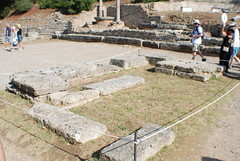
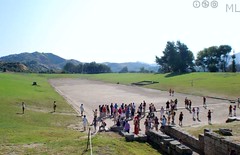
And of course we have a distant descendant of the Olympic Games that we celebrate today. When we do, the famous Olympic flame is actually lit here, on the ruins of the former Altar of Hera (pictured at left) using a parabolic mirror. And what visit to Olympia would be complete with a visit to the Stadium (at right)?
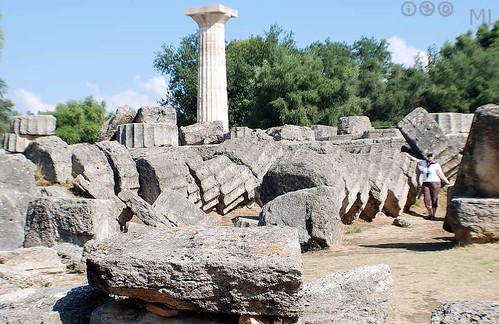
But for me these weren't the most impressive sights. No, I'm not talking about seeing Mount Olympus there (because it's actually in a whole different part of the country), but rather what would have been the ginormous Temple of Zeus!
Of course, it's in ruins now, and the colossal statue of the god which was one of the Seven Wonders of the Ancient World is long gone... but it is an impressive sight nonetheless. Just get a load of the diameter of the fallen pillars alone, with yours truly standing next to them for comparison! (See, that really must have been some earthquake!!)
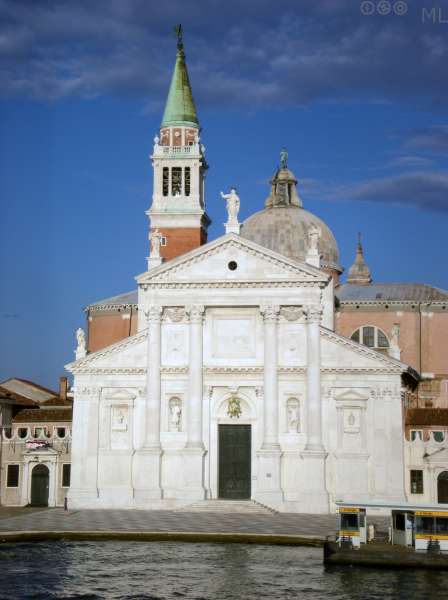
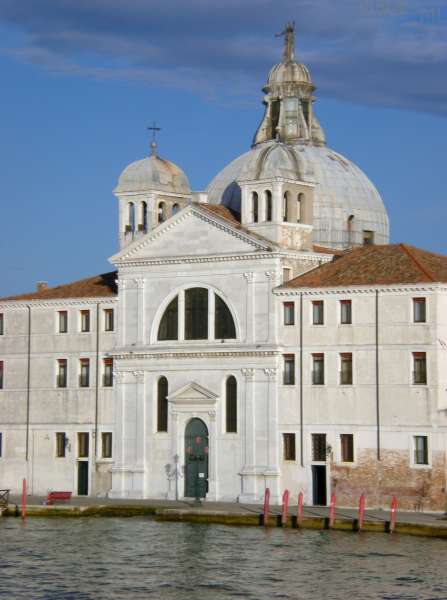
Yesterday, I caught the ferry boat that takes cars to Venice's beach island, the Lido. It passes through the wide Giudecca canal that forms the underbelly of the city, where you can get some unparallelled great Venetian views!
To wit, in one fell swoop, you can get a spectacular gander of not one BUT THREE churches designed by the virtuoso Renaissance architect Andrea Palladio!
As proof, I've uploaded to Flickr these shots of mine taken of the gleamingly gorgeous sixteenth-century white marble churches of San Giorgio Maggiore, the Zitelle, and the Redentore. Enjoy!!
Today was the annual celebration of Venice's "Marriage to the Sea," and a wonderful reminder of why I love this city.
It was Nan McElroy's blog Living Venice that reminded me that this weekend was the Feast of the Ascension, celebrated in quite a particular way by Venetians.
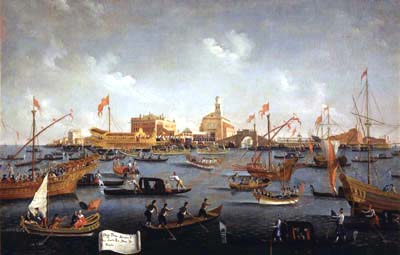
The "Festa della Sensa," as Venetians call it, has been celebrated for nearly a millennium. Probably the best read you can find about it is in Ed Muir's Civic Ritual in Renaissance Venice, but - as a quick intro - I can tell you that every year on the traditional Catholic feast day celebrating Christ's Ascension into Heaven after his Crucifixion, the city would take to its boats and row out to the end of the Lido barrier island, right in front of the Benedictine church and monastery of San Nicolò (as you can see in the image by eighteenth-century Venetian painter Gabriele Bella).
There, the Doge (the ceremonial head of the government) would drop a ring into the water, precisely where the Venetian lagoon met the Adriatic Sea, saying "We wed thee, O sea, as a sign of our true and perpetual dominion." (What can I say? Venetians were legendary for being more pragmatic than romantic!)
Today, a similar ceremony occurs, with the mayor standing in for the doge. But what really got me today was getting to wander around the old monastery complex of San Nicolò and the concert of seventeenth-century music which concluded the day's festivities.
Firstly, a couple of iPhone pics of San Nicolò... While most of the complex that one sees today (at left) is later than the sixteenth century, I have a soft spot in my heart for any and all remnants of the early Middle Ages. Sure enough, there is preserved a section of Romanesque-Byzantine mosaic pavement and some columns from the ruins of the nave of the older church, about a thousand years old! Even better is an easy-to-overlook tiny fragment of relief of an eagle, probably meant to be a symbol of the Saint John who is believed to have written one of the Gospels. But the evening's concert held in the church was the best part of the day! Firstly, as is the case with so many cultural events here sponsored by groups like Musica Venezia, it was FREE! (Particularly amazing when you consider that you'd be hard pressed to find anything of the like stateside at nearly any price!)
Secondly, the musicians (from the group VeniDilecteMi) were fantastic (6 male & female vocalists, 2 violinists, a viola, 1 lutist, and an organist), and performed music composed more or less at the same time as the present church of San Nicolò was itself was built, that is, during the 1600s.
As you can see, it was the perfect setting for these beautiful sounds, many of which had been taken directly from seventeenth-century music books and had never been performed in recent times!* (BTW, while the church is about 400 years old, the crucifix you see in the photo at left dates back about SIX HUNDRED YEARS, to the fifteenth century!)
Most of the works performed were very short, just a few minutes long, and written by minor, lesser-known composers of the time. But still Venice was a major cultural center of Europe, and was absolutely saturated with wonderful music by composers of all levels!
Here, for posterity's sake, is the great program they performed (with the pieces that really struck me in bold):
G.B. Bassani, Suonata IX (1683)
A. Balbi, "Laudabo nomen Dei" (1606)
A. Grandi, "Vocem Iucunditatis" (1637)
A. Grandi, "Quasi Cedrus" (1630)
A. Balbi, "Exsurgat Deus" (1606)
J.H. Kapsberger, "Toccata III" (1604)
F. Lucio, "Jubilate Deo" (1649)
A. Grandi, "In dedicatione templi" (1618)
A. Gabrieli, "Ego rogabo" (1576)
A. Grandi, "Bone Jesu Verbum Patris" (1621)
B. Marini, "Zarabanda III" (1655)
A. Grandi, "Benedictus Dominus" (1610)
J.H. Kapsberger, "Preludio in sol" (1640)
A. Grandi, "Deus canticum novum" (1628)
B. Marini, "Sinfonia IV tuono" (1655)
A. Grandi, "Anima mea liquidfacta est" (1630)
F. Cavalli, "Canzona a 3" (1656)
C. Monteverdi, "O Jesu vita mia" (1603)
G.B. Bassani, "Suonata VI (1683)
A. Grandi, "Memoriam fecit" (1621)
A. Grandi, "Ave maris stella" (1637)
C. Monteverdi, "Cantate Domino" (1620)
I'll just say one more thing: I learned today that there were a number of lesser-known composers whose work I really enjoyed. But then there was Monteverdi! (Along with Andrea Gabrieli, Monteverdi was the only other composer played today who was at all well-known; indeed, he is considered one of the earliest innovators of opera and is buried with honor in Venice's splendid Frari church).
As the program today said in his biography, "Claudio Monteverdi is one of the absolute musical geniuses of all time." Turns out that this is no understatement. After listening to several perfectly nice pieces by the minor composers of the era, I was utterly blown away by Monteverdi's "O Jesu vita mea"! There was simply no comparison between the unabashed virtuosity of his piece and the others. In fact, one of the earlier works had been called "Anima mea liquefacta est," which means "My soul is liquefied," and that was exactly how Monteverdi's composition - consummately performed in a lovely church constructed at just about the same time as his writing - made me feel! (Have I mentioned lately that God, I love this city?!)
*BTW, anyone interested in recuperating and performing this ancient music can find the musical notation for these pieces and others like them here!
I spent most of my Christmas break this year on the Venetian island of the Lido, where my in-laws live. It's largely a sleepy suburban version of Venice, with mostly 20th century houses and even cars. It does however have some attractions, which I should start to share here!
First of all, the Lido boasts one of the greatest concentrations of art nouveau villas in Italy (called in Italian "Liberty style.") Most chose to emulate the Venetian gothic palaces of the historic center, except with much more flourish.
To celebrate this unique twentieth-century heritage, the City of Venice has recently inaugurated a website dedicated to Liberty architecture on the Lido. So far, it's only in Italian, but a clickable list of the 250+ buildings catalogued with photographs is here.
Here are a couple of my favorites from the first 50... Enjoy!
Ah, where do I begin with the long, troubled saga of the new bridge over the Grand Canal?
Well, for centuries, there had only been ONE bridge over the Grand Canal, and that was the famed Rialto Bridge. Anybody who wanted to cross the 2+ mile long Canal Grande either had to schlep there or be ferried across by a gondola traghetto. Then, in the 19th and 20th centuries, two other bridges were added, which - if truth be told - made life A LOT easier for the Venetians. The same cannot be said of the new FOURTH bridge over the Grand Canal.
About 10 years ago, the city government first announced the building of a bridge that would link the bus station on the south side of the canal with the train station on the north. I remember when I first saw the project drawings by world-famous architect Santiago Calatrava... As you can see above, it was beautiful, without a doubt... poetry in glass, marble and brass, with some steps twice the width of the others so that folks could stand and admire the view. I could see why the mayor, who's also a professor at Venice's architectural university, wanted it.
But it also struck me as imminently impractical. Venice's bridges can already be slippery in the humid lagoon climate... This, I thought, is going to be like an ice rink.
And guess what? Now, over 10 years later, innumerable delays and astronomical building costs (more than ELEVEN MILLION EUROS, nearly fifteen million US dollars, and more than five million euros over budget) that's exactly what's happening.
The bridge officially opened without any fanfare on the eleventh of September of this year (since the inaugural celebrations were canceled in fear of a huge public protest). Almost immediately thereafter, several people would be injured when they lost their footing. It's gotten to the point that the Veniceword newsletter reports that folks all over the world have begun tuning into the bridge's new webcam to see if they can catch any of these Benny-Hillesque moments in real time. (What do you know... The camera seems to be down at the moment!)
The Venetian city government will not, however, intervene to make the bridge safer. You gotta love the official response: Public works councillor Mara Rumiz said falls on Venice bridges ''are natural'' and that it would be ''less complicated and less costly'' to put signs up alerting tourists to the problem rather than ''substituting parts of the bridge''.
And now, just to add insult to injury... or injury to injury, as the case may be, there may be now nothing to hang onto for safety as one crosses the bridge! It turns out that the gleaming brass handrail is becoming too hot to touch in Venice's recent spate of warm autumn weather. "I noticed that the upper handrail becomes burning hot. I'm afraid next summer it will be a problem," the Venetian Order of Engineers president, Vito Saccarola, was quoted as saying by news agency Adnkronos, and went on to describe the structure as "beautiful, but not indispensable."
And there you have it. Called for years the ponte di Calatrava and now christened the Constitution Bridge, the fourth bridge over the Grand Canal in Venice has become a symbol to all Venetians of not only the ultimate albatross, but also of the complete disconnect and disregard of the government about the human realities of the city.
It's the seeming victory of form over function, not to mention of tourist attractions over quality of life...
Most of us probably hardly notice much architecture... We think of it (if we think of it at all) as a passive structure, doing nothing but sheltering us from the elements as we go about our daily business. But when we "activate" architecture, in the most basic sense, we (consciously or subconsciously) deliberately interact with it, creating new, greater meanings and experiences as a result.
Perfect example was a *free* concert given in Venice last night by a major Italian artist, Angelo Branduardi. Now, it's hard to explain Branduardi if you haven't heard him (which you can do on his MySpace page, if you want...) He's kinda like a mix of Pink Floyd, ELO and Peter Gabriel, that is, if they were to play celtic/medieval music.
And the venue was extra-special! Branduardi played in the Basillica of Saints John & Paul (Santi Giovanni e Paolo), a medieval, Gothic church which would more than suffice as a cathedral in most cities (but just happens to have to play second fiddle, as it were, to Saint Mark's Cathedral here in Venice...)
Now, clever me... I managed to forget any and all of my little electronic gadgets which would have permitted me to share just a small snippet of the experience with you. (Actually, that's not quite true... I had managed to bring my digital camera; I just had forgotten its battery at home in the charger! Argh!!) So, let's see if I can even vaguely reconstruct the experience for you, here and now, approximating it with photos from Branduardi's fan club page...
The picture at right is a photo of the interior of the church (from its Wikipedia page, taken from near the high altar, looking back down the nave toward the entrance of the basilica). Needless to say, it's huge (just check out the difference in scale between the people and the ceilings!)
Imagine, if you will, this scene at night... and the church filled to standing room only. The focus of the concert was a pared-down presentation of Branduardi's album of songs to celebrate Saint Francis of Assisi. So, amplified, electric medieval music was reverberating off those splendid ceilings... (not to mention brooding shadows of the statues of various saints and the tombs of long-dead knights and rulers being cast by the red stage lights and then creeping down the walls).
Now, I've often heard the churches of Venice "activated" before, by organs, choirs, string quartets, and even Tibetan "throat singing" and a Flamenco Mass... although not at the same time! :-) But what a beautiful sound resonated from Branduardi's electric violin, as he sang lauds to St. Francis!
Even more glorious was when he closed the concert with a sweet ballad which had orginated on the medieval pilgrims' road to San Juan de Compostela in Spain called "La stella mattutina" (or "The Morning Star") on a lovely instrument he called the chitarra-arpa (or "harp-guitar"). I found what looks like a cellphone video from a smaller, more informal gig Branduardi played a few months ago, so at least this way you can get a (very!) small sense of the artist, the music, and that magnificent instrument (pictured at left)! Enjoy!!
 Well, as you can see in the sidebar, I do more FBing of my interesting weblinks than blogging nowadays, but I thought these photos were worth firing up Blogger for! ☺


 photohunt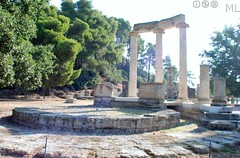




 Now, I've often heard the churches of Venice "activated" before, by organs, choirs, string quartets, and even
