Showing posts with label travel. Show all posts

The Iron Curtain Once Fell Here

This past spring, I was startled to realize that, for the first time ever, students to whom I was teaching the Cold War had never lived during the Cold War.

That's right, they were born after the attempted coup of August 1991 that effectively rendered the Soviet Union moot. Now, we've truly arrived at the end of an era, even though for years now I've already had to point out regarding the Berlin Wall and the Iron Curtain which was the physical barrier and which was the metaphor... ☺

As you will see, however, even metaphors have a history...

Yesterday, we were driving around the Collio "wine road" in the Italian region of Friuli near the Judrio river that forms there the Slovenian border, when we chanced to see a small gravel track on a little bridge which crossed the river bed. Thinking I'd suddenly get to add visiting an additional country (even just for a few minutes) to my vacation, I suggested we stop and walk across.

That's when my husband noted, "Once upon a time, this is where the 'Free World' ended."

Sure enough, I'd forgotten that not only was this the boundary between Italy and Slovenia, but it had also been the frontier between Western Europe and the communist East.

Now, however, the end of the Cold War and the Schengen Agreement unifying the borders of the European Union have rendered all that obsolete. So together we sauntered unhindered down a path which once separated two worlds...

What's left here where once the Iron Curtain fell? Not much... On the Italian side, there is a little checkpoint hut falling into ruin and a flagpole that used to fly the good ol' Red, White and Green. (Another view, together with the former crossbar, is here, and the bridge with the river here...)


On the other side, we found a building (now a private house) that had performed the same function for Yugoslavia (together with the unused flagpole) and the little hamlet of Mišček. At one time, there were in this village a number of inhabited structures, but it seems now that many are abandoned (as also pictured here).


A search for this placename came up with a traveler's account in Italian, which seems to put all these enormous geopolitical changes into context in this lonely rural place. "Here, everything's falling to pieces..." one inhabitant said. "Here, nothing's changed. Yugoslavia, Slovenia... it's all the same. Now, Europe... but what's changed? Here nothing."

UPDATED: "A Question of Taste"

According to the comic strip "Mother Goose and Grimm," the Wright Brothers invented airplane food using just flour, glue and mayonnaise.

Why does airplane food seem so tasteless? It might be because the average full meal is said to cost less than $3.50 per passenger (down from twice that last decade!) But maybe, just maybe, our own senses are to blame...

According to the Lufthansa in-flight magazine from May 2010, that airline contracted with the Fraunhofer Institute for Building Physics to test food in their decommissioned Airbus A310 fuselage fitted inside a huge low-pressure chamber (pictured at left).

In this research, they've discovered, for example, that tomato juice is not just consumed on flights because of the bloody marys! Instead, the mustiness of tomato juice when tasted on the ground apparently becomes refreshing and fruity at 30,000 feet (because, they say, that's when those usually-masked flavor notes are finally released).

We may likewise perceive the average airplane meal differently after take-off: according to the researchers, sugar seems about 20% less sweet in flight and salt about 30% less salty; spicy foods have to be made even spicier, herbs seem to lose their punch, while acids still manage to keep tasting every bit as sour.

Why the difference? Even back in 2005, a researcher at Surrey University had discovered that the combination of low air pressure and low humidity generally have a dulling effect on our tastebuds. As a result, he said, some (unmentioned) airlines apparently even have special kitchens which can replicate high-altitude conditions so that their chefs' compositions don't lose something in the translation between take-off and dinner time. In the end, Lufthansa itself declared, "These findings are in line with phenomena we already knew about and will be adopting in our recipes."
Hopefully, for long-haul flyers like myself, airlines will manage to get it figured out sometime before in-flight meals are eliminated all together! Or, as another editorial cartoon put it, "Sir, would you like juice, milk, a soft drink, coffee? Actually, it's just a rhetorical question."

UPDATED (7/27/2010): Everything you ever wanted to know (and surely way more!) about airline food can be found at AirlineMeals.net, including a gallery of meals from the '70s, '80s, & '90s! (via "50 Best Travel Sites You've Probably Never Heard Of")

Stop 5: Olympia

Olympia, Greece was of course the site for the ancient Olympic games. Now, since I'm only about two weeks away from starting to teach Western Civ again, I don't really feel like expounding to the point of writing a history lesson about it just yet... But I will post some of the more interesting photos with some thoughts on them.

Since Olympia was largely destroyed by what had to have been incredibly violent earthquakes in 522 and 551 A.D. (and you'll see what I mean about how strong it must have been shortly) nothing was left standing on the site. Anything you see arising above ground level is thus a reconstruction of the broken pieces that were found by archeologists. But even the sheer amount of the remains still on the ground is impressive.

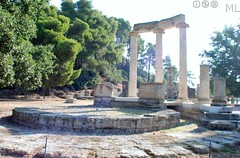
So, some highlights... Firstly, we have the only circular temple on the site, started by Philip II of Macedon and completed by his son Alexander the Great, called appropriately the Philippeion. While quite unusual, it nevertheless evinces what I expected to see from the site, I guess... the subtle elegance of the ancients. (Even if it had all been painted up gaudier than Las Vegas at the time!)

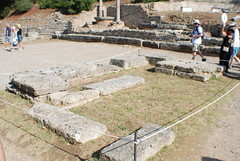
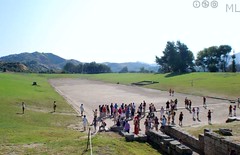
And of course we have a distant descendant of the Olympic Games that we celebrate today. When we do, the famous Olympic flame is actually lit here, on the ruins of the former Altar of Hera (pictured at left) using a parabolic mirror. And what visit to Olympia would be complete with a visit to the Stadium (at right)?

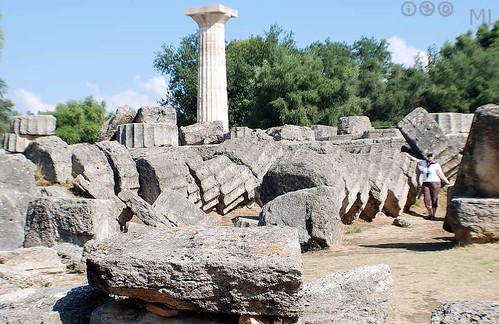
But for me these weren't the most impressive sights. No, I'm not talking about seeing Mount Olympus there (because it's actually in a whole different part of the country), but rather what would have been the ginormous Temple of Zeus!

Of course, it's in ruins now, and the colossal statue of the god which was one of the Seven Wonders of the Ancient World is long gone... but it is an impressive sight nonetheless. Just get a load of the diameter of the fallen pillars alone, with yours truly standing next to them for comparison! (See, that really must have been some earthquake!!)

Stop 3: Athens & Its Subway

Even though I took hundreds of photos in Athens, they were easier to weed through than I thought!

In part, we had far too little time in the city... only about 7 hours. Combining that with the fact that we were with our Athenian friend Vangelis meant that no local taxi driver would pick us up to take us to the Acropolis because he would have to charge us the "normal" fare! Seriously... we were rejected by like a dozen cab drivers - and it just got funnier every time - who were on their way to the golden goose which is the cruise ship. (Pretty quickly, I learned the Greek for "no"... oshi!)

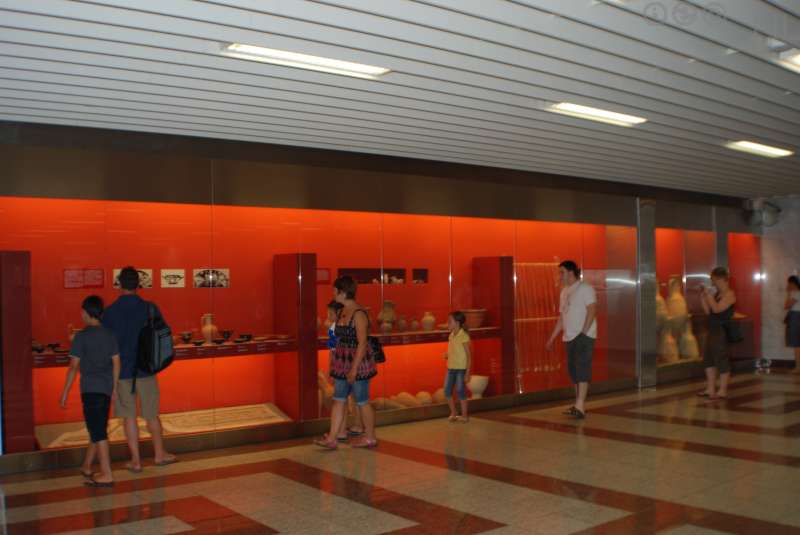
So, in the end, we only had enough time to see the Acropolis and the new Acropolis Museum. And there's practically no way to take a photo of the iconic Parthenon without it being totally cliched... So, I'll teach with those photos and won't bother posting them on Flickr or here. But what I will share are some photos from our cool trip through the Athens metro! Yes, you read that right... the lowly subway!!

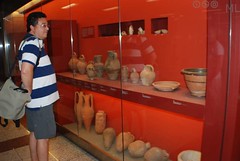
Needless to say, you can't dig a hole in downtown Athens without hitting something of historical value. As a result, in an unprecedented move, teams of archeologists worked alongside the metro engineers for a total of six years, uncovering a staggering 32,000 artefacts in the process! The end result is not only a greater knowledge of Athens' buried history, but also metro stations which double as museums! Totally cool.

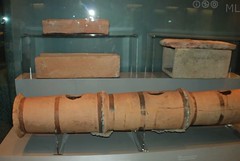
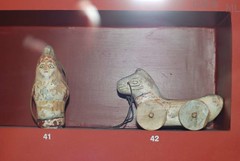
So, here are some glimpses of these clever exhibits at the Acropolis and the Syntagma Square metro stations... As you can see from the Acropolis stop above, a number of the artefacts (or their reproductions if they're simply too valuable) are on display, including the ancient Greek plumbing (!) and ancient toys exhibited at the Syntagma station.

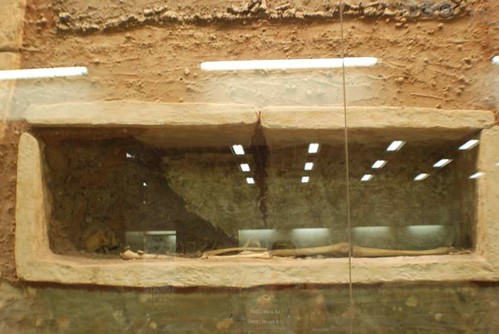
But at Syntagma they've done even more. Since subways by definition provide a great cross-section of the substrata beneath a city, they've displayed this behind a glass wall... so you can see perfectly well the ancient necropolis which originally occupied that site.

Complete, by the way, with an open grave and a skeleton in it! (I am assuming this is a reproduction, but I can't swear to it...)


Now why can't Rome do the same thing???

Stop 4: Mykonos


Again, jumping around out of order, photos from the beautiful whitewashed tourist trap that is the Greek island of Mykonos are now up in my Flickr photostream (and in my sidebar slideshow at right!)

Whew, that's pretty much it for the modern cities... now I have to face fixing up the hundreds of photos from classical Athens, Olympia and Delos!!

Stop 2: Corfu'

A little out of order in presenting my vacation pics, but it was actually easier to start the weeding out process with the ones from the island of Corfu'. A handful of new holiday snaps are thus now available in my Flickr photostream (visible in the slideshow in the sidebar).

More to come...

Dr. V and the Splendour of the Seas in Corfu'

Worst cruise photo idea EVAR!

I wanted to pose for it from behind the fishtank but they wouldn't let me!

(Just kidding...)

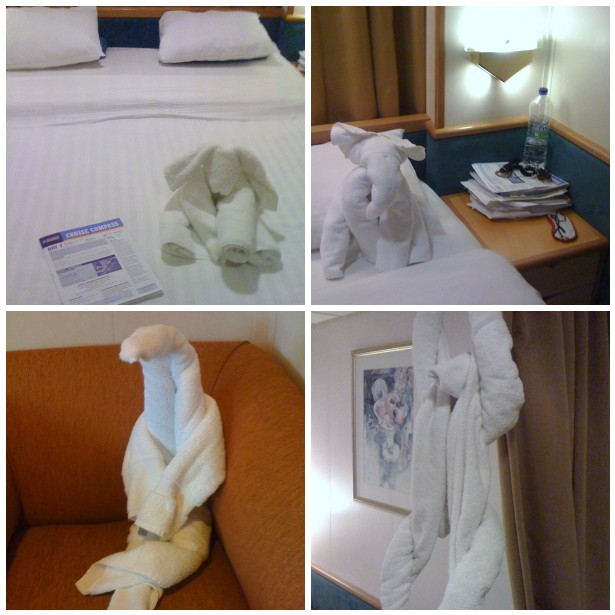
Proof that I'm easily amused...

A towel animals mosaic from last week's cruise through the Med!

Everybody Wants to Be a Cat... in Rome!

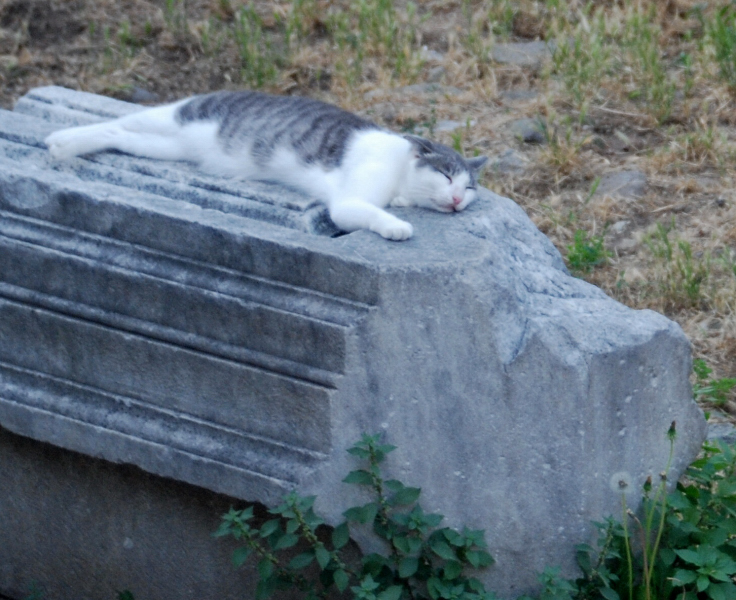
A note on the new pictures I've posted on Flickr... These photos were taken at the "Area Sacra" at Torre Argentina in Rome at the end of last month.

As you can see from the pictures, the ruins of at least 4 ancient Roman temples (some of the oldest ever found in the city!) were discovered here in the 1920s. Because this is now, as a result, a protected area smack dab in the middle of Rome, it - like the Colloseum and the Roman Forums - became preferred haunts of the Roman stray cats. So much so that now there's officially a cat sanctuary here (which you can visit virtually at romancats.com) and at last count there were something like 250 felines who call these ruins home! (And you thought that your local cat lady had a lot!!)

A few years ago, I actually saw a documentary called "Cats of Rome," directed by Michael Hunt, who spent - I heard - something like 3 years filming the project. In it, they discovered that these stray cats actually behave a lot like prides of lions on the African savannah! In fact, I felt kinda like I was on safari when I took these photos... :-) Not to mention that I couldn't get "Everybody Wants to Be a Cat" from "The Aristocats" out of my head!

What's more, in the Italian version (called the "Aristogatti"), O'Malley is actually dubbed with a Roman accent and calls himself "Romeo"! He continues in Roman dialect to say that he's "er mejio del colosseo" (or "the best cat in the whole Colosseum!" And, believe you me, with all those cats, that's really saying something!!)

P.S. Want to lend a hand to the Torre Argentina Cat Sanctuary, which has no government funding and lives off donations alone? According to ArkOnline...

"WHAT YOU CAN DO:
Torre Argentina urges animal lovers to send letters to Prof. La Rocca, the Roman authority in charge of the archeological site of Torre Argentina. Please ask La Rocca to approve plans for linking the shelter with the city's sewer system, so that the shelter can have proper drainage, running water, and toilet facilities.

For $15 a month, you can provide food and medicine for the cat of your choice. Torre Argentina will send you a picture and update on your feline friend and their life in Rome. To meet some of the cats... [write] Torreargentina@yahoo.com.

Additional tax deductible donations can be made in the United States through "In Defense of Animals," 131 Camino Alto, Mill Valley, CA 94941 (Be sure and write "For Torre Argentina Cats" on the front of the check)... Contributions can also be sent to Silvia Viviani, Via Marco Papio 15, 00175 Roma, Italy. Tel: 0348-384-5853 from 11 am to 7 p.m. (Roman time)."

UPDATED: Tales (and pictures) from the road less taken...

"The Road Not Taken"
by Robert Frost (1920)

TWO roads diverged in a yellow wood,
And sorry I could not travel both
And be one traveler, long I stood
And looked down one as far as I could

To where it bent in the undergrowth;

Then took the other, as just as fair,
And having perhaps the better claim,
Because it was grassy and wanted wear;
Though as for that the passing there
Had worn them really about the same,

And both that morning equally lay
In leaves no step had trodden black.
Oh, I kept the first for another day!
Yet knowing how way leads on to way,
I doubted if I should ever come back.

I shall be telling this with a sigh
Somewhere ages and ages hence:
Two roads diverged in a wood, and I—
I took the one less traveled by,
And that has made all the difference.


I've developed a new habit when I travel... I ask the locals, preferably in the best aproximation of the local language I can manage, what is the most beautiful thing to see there that few foreigners know about.


In Rome, at a wonderful little hole-in-the-wall trattoria at the foot of the Esquiline Hill, the answer I got was the Church of the Four Crowned Saints (i Santi Quattro Coronati)... so I promptly marched (as promptly as possible under the blazing Roman sun, which was, like, a good hour or two) up the Celio hill to this church, originally founded in 595 A.D.

There I met an elderly English gentleman, who'd just done the same... I told him my story, and he said that the folks at the restaurant were absolutely right... He'd first seen the church over 50 years earlier, when he was studying on a scholarship in Rome in the years after the war. There'd he'd seen a tiny little palm tree just starting to grow in the cloister garden. A few years later, he went back, and the same little tree was by that point astoundingly tall.


And now, here he was a half century later, and he'd come to Rome at least in part just to see the church and that once-little palm, to see how that tree - which was nearly as old as he - was doing... He'd marched up that hill, alone, in the ferocious heat like I did, only to discover that the Augustinian Sisters who occupy the convent and church were in the middle of closed religious devotions, and the church would not be open to the public as a result until the following week. And thus we traipsed right back down the Celio hill (the view of Colloseum at right was taken from that very street on the long way back...)


So, I guess the moral of the story is that we can't reasonably expect everything to be open 24/7 on the road less travelled! :-)


Still, I was glad to have tried, to have met that kind English gentleman and heard his story. Plus, I now have an even greater reason to return to Rome in the future... Someday, I have to see that church (not to mention the palm tree!)


We did the same thing in Tuscany, and the answer we got was the village of Montefioralle near the town of Greve in Chianti (where I got the shot I flickred earlier of the basketmaker at the annual Butchers' festival).


Don't bother to try to look for it in any guidebooks... chances are that it's not there. Not even in the Italian ones! But it has just been officially named as one of the prettiest villages in Italy, and once you see it you know that it's rightfully so!


The village began as a small fortified settlement by at least 1085, and is even mentioned in poetry by the famous early-Renaissance author Boccaccio. What's more, Montefioralle was the ancestral home of the family of Amerigo Vespucci, the Italian explorer who wound up giving his name to the Americas.


It was at this point that my husband, who'd until now just been patiently waiting for me as I was snapping my own photos, caught the shutter bug himself in this charming, medieval walled village! These photos are from his camera, while mine I'll post - as usual - to Flickr. Enjoy!!


UPDATED AGAIN: Excitement at the Palio!

Tonight was the running of the Palio, the famous, age-old horse race in Siena, Italy. Every year, twice a year, for hundreds of years, 10 of the 17 neighborhoods of Siena lay everything on the line to win this race, which lasts only 3 laps of the main city square and usually less than 90 seconds.

But the horses are chosen by lot. The jockeys – who ride bareback – are chosen by lot. The neighborhoods (called “contrade”) find most of their chances to win determined by, well… chance.

And yet the Sienese are completely passionate about this race. They organize their entire year around it, they’re utterly ecstatic when they win and they’re thoroughly despondent when they lose. And they’re even worse if their traditional “enemy” neighborhood (the “nemica”) happens
to be the one to win… That’s like adding insult to injury!


Want to see what I mean? These are my pictures from Friday, June 29th in Siena

First was the “Tratta,” or the Extraction of the Horses, in which the race officials drew by lot which horse would be assigned to which neighborhood. As you can see, a few people turned out to watch!


Everybody awaited each drawing with baited breath. People of the neighborhood kept track of every announcement on special forms handed out for the occasion, or else on scratch paper if they didn’t have one. (And the results of the drawing was the one and only thing that everybody in town was discussing all afternoon on their cellphones!)


When the contrada of the Snail (“Chiocciola”) were drawn to be the ones to race the horse Brento, the piazza exploded with joy. The residents of the neighborhood ran forward to collect their horse and lead it victoriously to its special stable (which you can see at right) for the event. Brento was one of the horses most favored to win. And Chiocciola had been feeling cocky anyway... Even prior to the Extraction, the men of the neighborhood (the “contradaioli”) had been leading their jockey to the each of the other neighborhoods and singing taunting songs in front of their headquarters. Now they were sure they’d win the big race 4 days later!

Meanwhile, in the neighborhood group we were standing in for the Extraction, the contrada of the Wave (“Onda”) were soooo disappointed, since they’d wound up drawing one of the most inexperienced horses.

But how quickly the wheel of fortune turns during the Palio! We came back to the main piazza (called the “Campo”) that evening to see the first trial race, or “Prova.” Again, as you can see, just a few people turned out to watch what in the end didn’t even count officially. Even still, against all expectations, we almost saw a real disaster there. No joke…

The one who starts the race, the “mossiere,” was unexperienced, and when he released the starting rope, apparently he didn’t do it quickly enough, and right at the start, Chiocciola's Brento tripped over the rope and fell, injuring himself, throwing his rider and knocking off two other jockeys (as you can see in my photos). But the trial race continued… and the previously despondent neighborhood of the Onda wound up winning. And previously exultant Chiocciola was nearly beside itself with grief, instead of victorious (as you can see at right) like they'd expected. How strange is Palio-fate!

Tonight, the real race was run. But Chiocciola wasn’t there. Painfully, the entire neighborhood decided to withdraw rather than risk the life of the horse (more than one of which has died during the race in previous years).

After 90 seconds and at least three other jockeys thrown, the race was won by the horse of the neighborhood of the Goose (“Oca”) by a nose over that of the Seashell (“Nicchio”), but then the city officials accidentally raced the flag of the 2nd place contrada outside the town hall by mistake. A near riot broke out between the two neighborhoods, until the ruling was corrected and Oca was officially given the win. (And that’s when the Italian national tv coverage ended. For all I know, the riot may still
be happening in Siena...That's how seriously they take the Palio there!!)

When the race is posted online, I highly recommend watching it. The passion of the Sienese over this race defies all attempts at explanation!
UPDATED: You can check out the video here!


AUGUST UPDATE:

  • The Palio della Assunta will be run in Siena on August 16th, at 1 pm EST.
  • The contrade scheduled to run are Giraffa, Leocorno, Lupa, Chiocciola, Onda, Istrice e Civetta, Bruco, Valdimontone and Drago.
  • The "tratta" or extraction of the horses will take place August 13th.
  • The 6 "prove" or the trials will be run between the 13th & the 16th.
  • The corteo storico or historical procession will feature more than 600 costumed marchers and performers, and will run for 3 hours before the race!

Phantastic Photography!!

I want to be Trey Ratcliff when I grow up!

His photo, Fourth on Lake Austin, just won the Annual Smithsonian Magazine Awards in the "Americana" category. Congrats!!

I not only continually run a slideshow of his stuff at the bottom of my page (page down to see!), I've blogged about his Bloggies-nominated photography site "Stuck in Customs" before. And it just keeps getting better and better... Right now, Trey's blogging about shooting Cambodia in his signature "high dynamic range imaging" style!

What's more, a beautiful overview to his work has just been launched at http://www.treyratcliff.com, where you can gaze and marvel at slide shows of his portfolio, subtitled "Yearn," "Aspire," "Hope," and "Dream." Don't miss a single section!!

Stuck on "Stuck in Customs"!


Okay, I admit it... I don't handle obstacles well. Or maybe I do... I guess it all depends on your perspective!

First, I "work the problem," then I "overwork the problem" and finally, barring any success from that, I just go ahead and bulldoze any remaining roadblocks. :-)

Case in point, this morning: I've just discovered a wonderful travel photoblog called "Stuck in Customs," and I wanted to add a slideshow of its breaktaking images to my sidebar here at MMC. Easier said than done! Two hours later I had to strike a compromise... the sidebar proved too much for me, so now it's at the bottom. (Scroll down and click through!)

The photographer, Trey Ratcliff, specializes in High Dynamic Range photography. He writes,

HDR enables the photographer to create a color and light palette that goes beyond the normal aperture and shutter speed of the basic shot.In my judgment, a well-executed HDR image is evocative of the actual scene itself. When a human eye is actually on location, it is constantly moving, adjusting the pupil size, allowing in more light in some areas, less in others, and the visual cortex actually works to build a patch-like vision of the scene. That is what we remember in our mind’s eye: an idealized super-realistic memory of the scene. HDR appeals to those people that actually see the world like this.

HDR normally involves multiple exposures of a scene at different stops (i.e. +4, +2, 0, -2, -4). These images are then processed and tone mapped for contrast and luminosity settings in sort of a techno-custom-software-darkroom until a light balance is achieved.

Technobabble? No, it's pure magic! Just wait until you see the results!!

I first discovered "Stuck in Customs" because it's been nominated for one of the 2007 "Bloggies" Awards. Best of luck, Trey!!