(from Buongiorno Venezia - The News from Venice)
On a side note, strangely, I seem to post my rare news items on Venice's notorious pigeons on the same day each year...

When a human eye is actually on location, it is constantly moving, adjusting the pupil size, allowing in more light in some areas, less in others, and the visual cortex actually works to build a patch-like vision of the scene. That is what we remember in our mind’s eye: an idealized super-realistic memory of the scene. [High Dynamic Range Photography] appeals to those people that actually see the world like this.

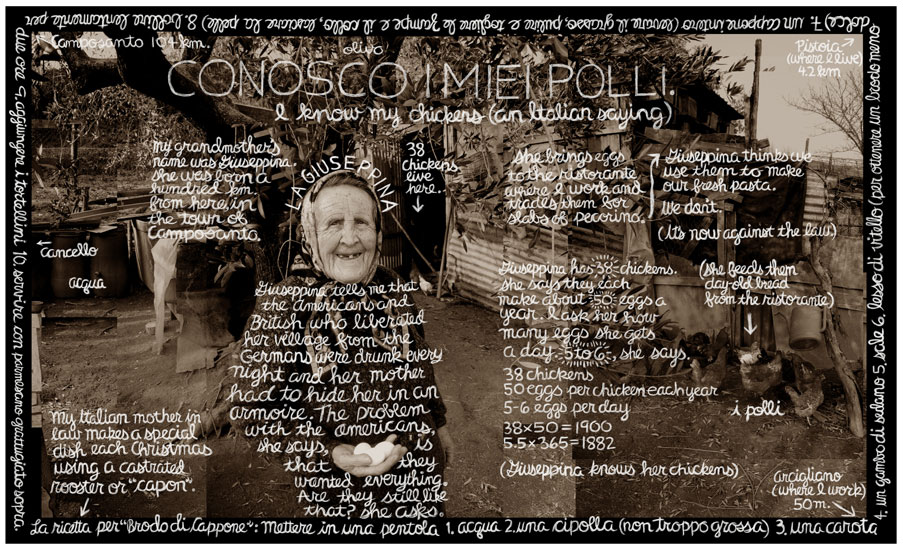
Douglas Gayeton has explored Tuscany and the heart of Italy's "Slow Living" culture since the early 90's. With a keen eye for stories and an ear for Italian dialect, he he intertwines the literal with the figurative in a photographic approach he calls the flat film. To become immersed in one of these works is to experience a world where time is at once collapsed and expanded. Regarding his work process, Gayeton says, "I've always seen photography as being about a single moment, whereas film is about orchestrating a sequence of moments (scenes) to create a larger narrative.

 Here are some more snapshots taken in Siena during preparations for the last Palio in July. (You can read, if you'd like, my blog post about it here!)
 These shots are mostly of the little contradaioli, the little kids of each neighborhood who get free bleacher seats for the trial runs (and intensive socialization in their neighborhood fanaticism!)


"The gondola is an important part of the Venetian scene, more than folklore it is a typical lagoon boat; it is the product of an ancient constructional art improved on through the centuries to create an object which is perfect both from the functional and from the aesthetic point of view. It might almost be a product of industrial design or, rather, of nature, like the seashell. From the functional point of view the gondola embodies the characteristics of other typical lagoon boats, also very beautiful, such as the "caorlina" or the "sandolo": lightness, shallow draught, minimum resistence to water, great manoeverability, remarkable carrying capacity in relation to its weight and size. These characteristics are strictly bound to the topographical needs of the city. A gondola is a very tough and complex structure, the hull alone is made of 280 pieces of seven different kinds of wood. Intended normally to be rowed by a single oar, the gondola has an asymmetrical plan, being more curved to the left than to the right, to balance the side thrust of the oar; it is also asymmetrical in section, leaning to the right, to balance the weight of the gondoliere. From an aesthetical point of view the gondola has been traditionally famous for its elegant shape; it has numerous interesting details, besides the "ferro" on the prow, there is the "forcola", rowlock of walnut wood, carved like a piece of sculpture. The poop daringly high about the water level, jutting out to take the weight of the gondoliere, with its absolutely pure line, it is perhaps from an architectural point of view the most beautiful part of the gondola."

